
Since Russia launched its ground war against Ukraine on 24 February 2022, the conflict has occupied most of the news coverage on western television and radio channels. On the onset of the conflict, reports of Russian troops marching on Ukrainian territory created overwhelming feelings of shock, anger, and resentment on western airwaves. Four months into the conflict, the initial shock has subsided, and a few trends have emerged in discussions about the war. In the context of AfriKili, I’m interested in discussing the impact and reactions of Africans on the African continent and in the diaspora.
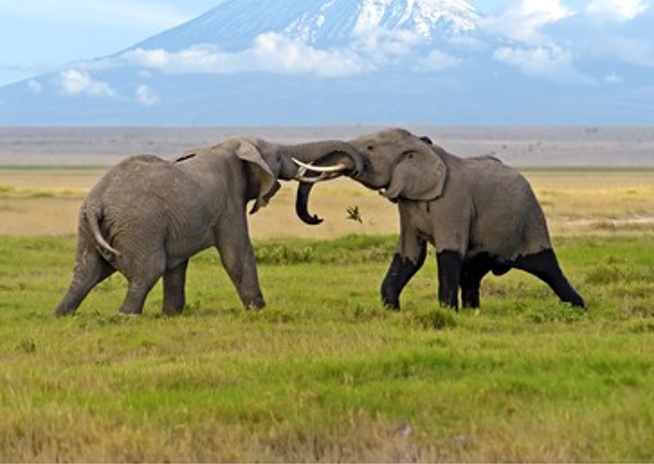
There is a powerful African proverb that states, “when elephants fight, it is the grass that suffers.” If we are to apply this metaphor to the war in Ukraine, it is necessary to clarify who are the elephants and who is the grass.
The elephants are Russia and the West, led by the United States and European Union countries such as France and the United Kingdom. Even though Ukraine and Russia are the only nations officially engaged on the battle front, Ukraine is clearly a proxy for the West. Understanding that a clear Russian victory could shift the regional geopolitical balance of power and pose an existential threat to the hegemony of the current world order, the West is mostly standing unified in its desire to help Ukraine repel the attacks of its powerful neighbor.
The grass in our proverb is represented by all the people that are hurt, killed, or caught in the crossfire, without asking to be part of the war. The innocent Ukrainian population is part of the grass in our metaphor. However, in the context of AfriKili, I will focus on Africans that are also caught in the crossfire despite no desire to be part of the conflict. I will specifically look at 3 events.
Firstly, there was the degrading and dehumanizing racism faced by black people at the beginning of the war. When the Ukraine invasion began, expectedly, hundreds of thousands of people became displaced while attempting to escape the battle grounds. As the displaced populations reached the Polish border on the western part of Ukraine, some of them were warmly welcomed into Poland. Unfortunately, as the masses were getting through the border checkpoints, we witnessed the nauseating treatment inflicted on black people that were in the crowd. They were separated from white people and were prevented at gun point from crossing into Poland, simply because their skin was black. The segregated group was mostly made of young black college students who had been studying in Ukraine. It took an international uproar for Poland to finally let the group of black people into the country, just as they were providing refuge to the other white displaced populations.
Secondly, there were the United Nations’ General Assembly votes to sanction Russia for its invasion of Ukraine. Similarly to the cold war era that pitted the Soviet bloc against the West, African countries were once again pressured to expressly chose a side in the current Russia-Ukraine war. This time around, unlike the cold war era, several African countries refused to align with the West and voted against the sanctions. A few other African nations decided to abstain from voting. This was not a surprising outcome given that, in the last few years, an increasing number of African countries have signed military and economic agreements with both Russia and China. Consequently, their votes or abstention was simply the confirmation of a trend that has been occurring for several years. Seeing that agreements with the West have historically led to the unfair exploitation of their resources and manipulation of their political systems, African countries are turning their eyes towards the East for new partnerships.
Thirdly, the conflict is creating major wheat supply disruptions around the world, with Russia and Ukraine accounting for most of the global supply. Africa could potentially pay a heavy price because Russia is flexing its “food power” muscle by enforcing a blockade that is preventing cereal shipments from leaving Ukrainian ports. The continent is facing the scary prospect of a food shortage. To discuss the problem, Russian President Vladimir Putin, invited Senegalese President and current chairman of the African Union, Macky Sall, in the city of Sochi on 3 June 2022. President Sall was accompanied by the chairman of the African Union Commission, Moussa Faki Mahamat from the country of Chad. According to a press release from Macky Sall’s office, the Russian president and his guests discussed the release of stocks of grain and fertilizers because the blockade particularly affects African countries.
The 3 events I described illustrate how Africa is part of the grass in the Russian-Ukrainian conflict. Therefore, I ask myself the question: do Africans want to keep being the grass that gets trampled, or do they want to be elephants that stand their ground and rebuff incoming attacks?
Upon reflection, the answer is clear to me: Africans should obviously not aspire to be the grass that gets trampled, nor should they aspire to become the proverbial elephants. As impressive as the elephant metaphor comes across, the notion still lacks ambition. Instead of wanting to be elephants, Africans should aspire to be mighty lions, capable of terrifying all potential attackers with a mighty roar. However, regardless of whether Africans want to be mighty lions or elephants, the central idea is about gaining enough strength to command respect on the international community stage.
How exactly can Africans accomplish such a lofty objective? By creating a United States of Africa.
To be clear, when I am referring to “Africans”, I am not simply referring to Africans in the African continent. Instead, I am referring to the entire African diaspora across the world.
If you are new to AfriKili, this platform advocates for the creation of a United States of Africa as a way of destroying the status quo and finally allowing the African continent to fulfill its potential. We believe that, in the process, Africa would become an economic and political powerhouse commanding respect across the world. A creation of a United States of Africa would not only be to the benefit of Africans on the continent, but the entire African diaspora in the Americas, Europe, the Caribbean, or Asia. A strong United States of Africa would be a powerful tool to help reform societies and eliminate systemic injustices against black people that were enacted hundreds of years ago, and that continue to create biases in our societies today.
The existence of a strong United States of Africa would have prevented Africans from being the grass in the 3 examples I mentioned above.
In the case of black people being segregated from the crowd fleeing Ukraine and prevented from crossing into Poland at gun point, the fear of retaliation would have prevented the overt racism that was displayed by Polish guards. For example, if the black people fleeing the conflict had been clearly identified as American citizens, the Polish would have provided clear passage without hesitation, to avoid any sort of retaliation from the powerful United States of America. It is true that American citizens sometimes face injustices in different countries. However, for the most part, the country’s military and economic power provides a protective shield to its citizens around the world.
In the same line of idea, a powerful United States of Africa would command justice and respect for black people around the world, including within the United States of America. Preconceived notions and systemic racism grounded in historical fallacies are still causing disrespect and discrimination for black people all over the world. A powerful United States of Africa would create a powerful protective shield for black people around the world and be a catalyst to eradicating systemic discriminations.
In the case of African countries being pressured to expressly chose a side during the United Nations General Assembly’s votes to sanction Russia for its invasion of Ukraine, it comes down to power dynamics in international relations. Clearly, the United States of America and other nuclear-power states do not experience the same amount of pressure or scrutiny when votes are brought up at the U.N. General Assembly. Instead of being pressured by other nations, countries like the USA are often the ones influencing agendas and discussions within the United Nations. I believe that a powerful military and economic United States of Africa would similarly shield Africans from this type of voting pressure, while providing the necessary clout to influence agendas being discussed within the international community.
In the case of grain shortage, it is an absurdity and an aberration that Africa could face a famine simply because Russia is enforcing a blockage preventing grain shipments from leaving Ukrainian ports. Africa has millions of hectares of unused arable land, sufficient to not only produce enough wheat to feed its entire population, but also become the leading exporter.
Looking back at world history, we can see that wheat has often been a strategic ingredient allowing world powers to strengthen their positions. For example, during the Cold War, the USA was able to use its growing wheat production to package military support and food aid through its famous Marshall Plan offer, as an incentive for its allies against the Soviet bloc. Similarly, in less than 20 years, Russia was able to become the biggest exporter of wheat and increase its geopolitical power by intentionally investing in its agricultural capacity.
The times are too grave for Africans to continue being dependent on wheat imports for such a strategic ingredient to feed its people. I believe that a strong United States of Africa would allow Africans to aggregate the resources needed to implement a dedicated agricultural plan across the continent and maximize the output of its arable lands, just like Russia did.
As I previously stated, Africans must gain enough strength to shatter the historical pillars of systemic injustices against black people, but also command respect in international relations. Africans do not have inherent deficiencies that makes them incapable of changing the narrative and becoming mighty lions. It is true that when elephants fight, the grass suffers. But it is also true that a roaring lion kills no game. Consequently, if Africans are to become lions, they also need to develop the strength to attack in unison, when necessary. Ultimately, I believe that the creation of a United States of Africa offers the best path forward for black people in Africa, the Americas, the Caribbean, Asia, and everywhere else in the international community arena. Let’s get to work!
AfriKili, African Intelligence to Build a New Africa!

 AfriKili
Leave a comment