
Summary:
- Introduction
- Unity’s relevance to AfriKili’s mission.
- Prestigious and Shameful ancestry: European vs. African
- The contrasting celebration of European and African ancestries
- Pan-African pride is there for all to see
- Pan-African connections of the past
- Dr. W.E.B. Du Bois relocates to Africa
- Dr. Martin Luther King Jr. gets inspired in Africa
- Malcom X longs for Pan-Africanism and unity among African-heritage peoples
- America influenced Dr. Kwame Nkrumah’s Pan-Africanism
- Dr. Walter Rodney, the Caribbean’s guerilla intellectual
- The Pan-African diaspora is full on Pan-Africanism apologists
- Conclusion
- Let’s get inspired!
Introduction
Jambo, AfriKili nation!
I have heard so many times that continental Africans and the global Pan-African diaspora are too different and cannot form coalitions or work together. But is that really the case? In this blog entry, part 2 of our 3-part series on Unity in the Black world, I want to dispel that idea. More specifically, I will look at both history and the present to demonstrate that connections between the African continent and the Pan-African diaspora are still very strong. As a matter of fact, despite the appearances, the bonds were never completely severed. There are countless instances were Black people in Africa and people of African descent in the diaspora successfully joined forces to target common causes.
Unity’s relevance to AfriKili’s mission.
Unity in the Pan-African world is central to advancing the #AfriKili movement. AfriKili exists to build bridges between Africa and the global Pan-African diaspora, in order to change the image and destiny of Black communities. AfriKili focuses on 3 pillars: highlighting Pan-African history, advancing Pan-African business opportunities, and driving Pan-African political action. Ultimately, AfriKili’s vision will not materialize unless continental Africans and the global Pan-African diaspora join hands. Unifying and building coalitions around their common African ancestry is a source of strength and enlightenment.
Fasten your seats belts, let’s dive in, and let’s get to work.
Prestigious and Shameful ancestry: European vs. African
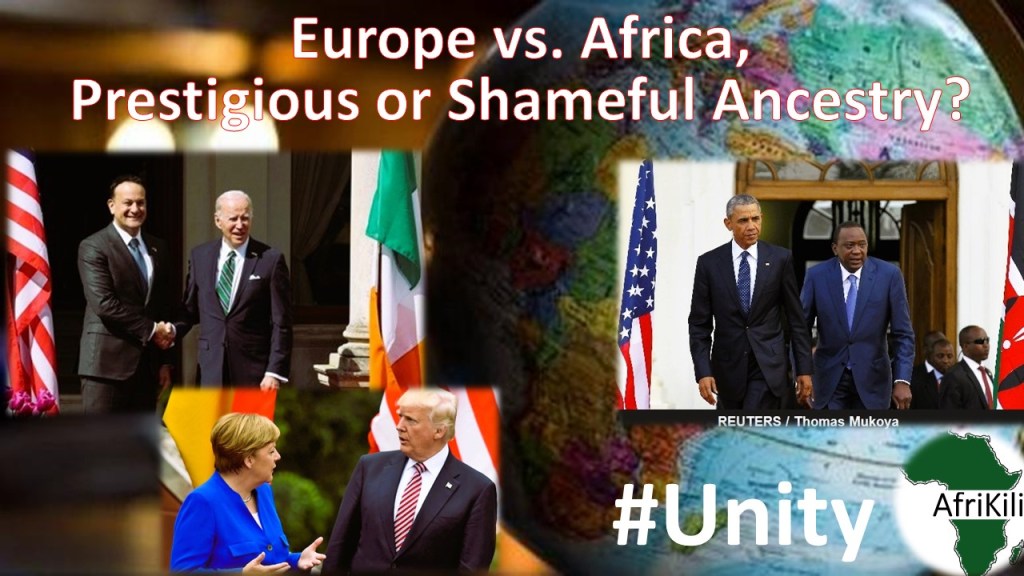
Before addressing the issue from the perspective of the general Pan-African population, I would like to briefly revisit how the last 3 Presidents of the United States of America received drastically different reactions when they embraced their foreign ancestry. I am referring to the Irish, Joe Biden; the German, Donald Trump; and the Kenyan, Barack Obama, who were respectively the 46th President, the 45th President, and the 44th President of the USA.
In the guest book of the Dublin presidential residence, Joe Biden–the 46th President of the USA–wrote the popular Irish proverb: “Your feet will bring you where your heart is!” The proverb was a favorite of President Biden’s grandfather, and he decided to write it down in April 2023, during a 3-day visit of his ancestral homeland. The proverb clearly implied that Joe Biden’s heart resides in Ireland. Furthermore, after returning to the USA, President Biden continued expressing his love for Ireland by describing the trip as being deeply personal and a return to his home.
As heartwarming as it was to see President Biden reconnect with his roots, the public’s reaction to this ancestral connection was diametrically opposed to that of former President Barack Obama, whose father was from Kenya, in East Africa.
President Biden was able to overtly express his love for his foreign ancestral home without generating an uproar. In contrast, the mere association of President Barack Obama to his father’s homeland of Kenya, brought up a plethora of criticism. During President Barack Obama’s first presidential campaign and his subsequent residency in the White House, loud mouths in the media and a segment of the extreme right went as far as questioning the authenticity of his U.S. citizenship. Some critics going as far as requesting that he be returned to “his” country of Kenya.
As heartwarming as it was to see President Biden reconnect with his roots, the public’s reaction to this ancestral connection was diametrically opposed to that of former President Barack Obama, whose father was from Kenya, in East Africa.
Let’s also remember that Donald Trump rode the racist sentiments against Barack Obama and manipulated his audience by claiming for several years, that he possessed “THE” birth certificate confirming suspicions about Barack Obama. Eventually, he recanted his false claims after launching his own presidential campaign. Nevertheless, this is ironic considering that President Trump’s followers often praised his grand-father’s European German origin as a symbol of his authentic and hard-working nature.
The contrasting celebration of European and African ancestries
Beyond the world of politics, there is a sentiment that Americans of European descent can freely display their ancestral roots from Germany, Poland, Italy, Greece, Scandinavian countries, etc. There are countless festivals across the United States celebrating European heritage, such as Oktoberfest, St. Patrick’s Day, etc. However, when it comes to expressing African ancestry outside the African continent and highlighting connections to Africa, there seems to be less enthusiasm and acceptance.
Unfortunately, this sentiment can also be observed within Black communities around the world. Continental Africans, African Americans, Afro-Caribbeans, and other black communities in the global Pan-African Diaspora are often influenced by negative stereotypes of each other. As a result, they often struggle to express their shared ancestry and bonds. The negative stereotypes can prevent interactions between different Black communities and create the appearance of unsurmountable differences.
Continental Africans, African Americans, Afro-Caribbeans, and other black communities in the global Pan-African Diaspora are often influenced by negative stereotypes of each other.
However, it is worth noting that these stereotypes and differences can be surmounted. There is ample evidence that connections to Africa and collaboration between different Pan-African communities is not only possible in our current times, but existed in previous generations.
Pan-African pride is there for all to see
Currently, there is an increasing number of celebrities such as Oprah Winfrey, Louis Gate Jr, Beyonce, Stevie Wonder, Mike Tyson and so many others, that have proudly reconnected with their African roots. They often publicly disclose the results of their ancestry DNA tests, and they strive to elevate elements of African culture. Beyond reconnecting with their African roots, there are countless everyday people of African descent that are relocating to Africa. I previously wrote a series of articles and recorded 3 podcasts exploring this “Black Exit” movement known as “Blaxit.”
There are also several present-day activists that are connecting issues within the global Pan-African world. For example, there’s the Pan-Africanist Kemi Seba, born in France from Beninese parents. In his latest book, “Philosophy of Fundamental Panafricanity,” he proposes solutions to help advance the cause of Afro-descendent people across the world. Over the years, he has worked to organize French-speaking Black communities in Europe, Africa, and the Caribbean.
Another name that comes to mind is Ayọ Tometi, who was born in the USA from Nigerian immigrants. She is a co-founder of the “Black Lives Matter” (BLM) movement that gained global recognition in 2020. The BLM movement became associated with organized protests denouncing police brutality after the murder of the African American George Floyd, by a police officer in Minnesota in 2020.
Pan-African connections of the past
If we look back to history, the Jamaican Marcus Mosiah Garvey Jr. is often cited as the main figure in the Pan-African diaspora who actively worked to create tangible connections between the African continent and people of African descent around the world. Through his New York City-based organization, the Universal Negro Improvement Association (UNIA), it is undeniable that Garvey helped restore a sense of African pride in the diaspora and a desire to connect with the continent.
However, there are many more names such as W.E.B. Du Bois, Martin Luther King Jr and Malcom X that are just as relevant to this topic. These three names are often associated with the African American struggle against racial inequality in the USA. Surprisingly, both continental Africans and African Americans are often unaware that these three individuals also expressed a deep connection to the African continent and even longed for stronger unity between people of African descent.
Dr. W.E.B. Du Bois relocates to Africa
Back in the late 19th century and early 20th century, there was the illustrious Dr. William Edward Burghardt Du Bois, also known as W.E.B. Du Bois, born in 1868 in Massachusetts, USA. He was the first African American to earn a doctorate at Harvard University, and he was one of the founders of the National Association for the Advancement of Colored People (NAACP) in 1909.
In addition to his strong militancy to eradicate racial injustice in the USA, he also advocated for building a free and strong Africa to help champion the cause of Black people around the world.
Towards the end of his life, he emigrated to Ghana, West Africa, and was one of the leaders of a group of Afro-Americans expatriates that later included the poet, Maya Angelou. W.E.B. Du Bois was treated like a King by Ghanaian the President, Kwame Nkrumah, and he was given all the support he needed to continue advancing his intellectual work. He died and was buried in Ghana in 1963.
Dr. Martin Luther King Jr. gets inspired in Africa
Dr. Martin Luther King Jr. drew inspiration and felt reinvigorated from this experience in West Africa. In 1957, when Ghana became the first African country to gain independence from colonial powers, the Prime Minister and soon to be President, Kwame Nkrumah, invited Dr. King to attend the independence ceremony.
Before travelling to Africa, Dr. King was becoming disillusioned by the extreme violence inflicted on African Americans after the Montgomery bus boycott successfully concluded. However, what he witnessed in Africa, renewed his hope that white supremacy would eventually be toppled, as he described in his “Birth of a New Nation” sermon.
It is not often publicized that Dr. King was referring to Africa when he first publicly proclaimed his “free at last” cry for freedom.
It is not often publicized that Dr. King was referring to Africa when he first publicly proclaimed his “free at last” cry for freedom. Like many civil right activists that were influenced by the decolonization movements in Africa, Dr. Martin Luther King was linking the fight against colonialism in Africa to the African American fight against segregation.
Malcom X longs for Pan-Africanism and unity among African-heritage peoples
Malcom X’s father was a leader within Marcus Garvey’s UNIA Back-to-Africa movement. As a child, he often attended meetings where his father and other UNIA members discussed the message of Marcus Garvey and talked about the African promise land. After his father’s assassination, Malcom X became a troubled child, went to prison, and lost all connections to Africa.
However, after he came out of prison and became one of the most prominent American Civil Rights voice in the fight against racial discrimination, he travelled to Africa in 1964. During this trip, his love for the continent reemerged and he remained connected to the continent until his assassination in February 1965. As evidence of Malcom X’s desire for more unity and collaboration with continental Africa, here are a couple of quotes from his book titled “The Autobiography of Malcom X.”
The first quote came from a speech Malcom X gave in Nigeria, at the Ibadan University’s Trenchard Hall in May 1964:
“I said that physically we Afro-Americans might remain in America, fighting for our Constitutional rights, but that philosophically and culturally we Afro-Americans badly needed to “return” to Africa—and develop a working unity in the framework of Pan-Africanism.”
Malcom X, The Autobiography of Malcom X, Chapter 18
The second quote came from a speech given while visiting Ghana, where several African Americans expatriates such as Maya Angelou lived:
“…the 22 million Afro-Americans in the United States could become for Africa a great positive force—while, in turn, the African nations could and should exert positive force at diplomatic levels against America’s racial discrimination…. Can you imagine what can happen, what would certainly happen, if all of these African-heritage peoples ever realize their blood bonds, if they ever realize they all have a common goal—if they ever unite?”
Malcom X, The Autobiography of Malcom X, Chapter 18
Malcom X understood that continental Africans and the global Pan-African diaspora would benefit tremendously and overcome racial injustice against Africa-heritage peoples if they worked together within Pan-Africanist frameworks.
America influenced Dr Kwame Nkrumah’s Pan-Africanism
Interestingly, the three prominent Afro-American figures mentioned above—W.E.B. Du Bois, MLK Jr. and Malcom X—were all hosted in Africa by Kwame Nkrumah, the first president of Ghana, after the country gained its independence. This is not surprising considering that Kwame Nkrumah studied and lived in the USA for 10 years, before returning to Ghana and becoming one of Pan-Africanism’s biggest champions.
While in the USA, he was intricately linked to the Civil Rights movement and struggle against racial inequality. His American experience influenced his unrelenting determination to free Africa from all forms of colonialism and advance the idea of Pan-Africanism. Kwame Nkrumah believed that continental Africans and people of African descent should come together and join their efforts. He believed that unity was the only way to build a powerful political and economic African continent, while eliminating racial discriminations against Afro-descendent people outside Africa.
Dr Walter Rodney, the Caribbean’s guerilla intellectual
As the first African country to free itself from colonial powers and gain independence, Ghana was a natural attraction for Afro-Americans and people of African descent across the world. However, other African countries also attracted Afro-descendants from outside the continent. Countries such as Guinea, Algeria, and Tanzania where the theater of successful collaboration between continental Africans and Afro-descendants from the global Pan-African diaspora. One such example is that of the Guyanese-Jamaican guerilla intellectual, Dr. Walter Rodney. After completing his graduate studies in London, he relocated to the East African nation of Tanzania, 6 years after the country gained its independence. He was welcomed by the socialist president, Julius Kambarage Nyerere.
It was in Tanzania that Rodney finished his magnum opus, “How Europe Underdeveloped Africa.” He argued that European colonialism had not just derailed Africa’s natural development, but led to the continent’s underdevelopment.
He argued that European colonialism had not just derailed Africa’s natural development, but led to the continent’s underdevelopment.
While in Tanzania, he also influenced the creation of the Dar Es Salaam school of intellectual inquiry; a school focusing on understanding how to successfully eradicate imperialism and successfully navigate decolonization.
The Pan-African diaspora is full on Pan-Africanism apologists
The names I mentioned above are a miniscule fraction of the thousands of prominent figures that have played a key role in publicly advancing a message of unity and collaboration between continental Africans and the global Pan-African diaspora. There are countless other influential names such as the South-African artist, Myriam Makeba; the Trinidadian Pan-Africanist, Stokely Carmichael; the Trinidadian lawyer and organizer of the 1st Pan-Africanist Conference, Henry Sylvester-Williams; the African-American poet and civil rights activist, Maya Angelou; the African-American former union soldier, historian, and denunciator of the horrors committed by King Leopold II of Belgium in the Congo Free State, George Washington Williams; just to name a few.
Conclusion
As I am concluding part 2 of my 3-part series on the strong connections between continental Africans and the Pan-African diaspora in America, Europe, the Caribbean, and the rest of the world, I would like to reiterate the importance of this topic to AfriKili’s mission. Pan-African communities cannot establish the successful coalitions we week and eradicate structural racial biases against people of African descent, if their interactions are guided by inaccurate stereotypes of each other. They must systematically build relationships, establish trust, and learn their common history.
In part 1 of this series, I made the case for uniting and building powerful coalitions by shifting our approach from highlighting our differences, to focusing on our similar shared experiences. In this entry, part 2 of the series, I hope to have dispelled the idea that continental Africans and the global Pan-African diaspora cannot effectively collaborate or form coalitions to target common causes. Through the examples I mentioned, it is evident that connections between the African continent and its global Pan-African diaspora are strong and were never completely severed.
In our next blog entry, the 3rd and final part of this series, I will explore how continental Africans and the global Pan-African diaspora can concretely build coalitions and enhance their respective conditions.
Pan-African communities cannot establish the successful coalitions we week and eradicate structural racial biases against people of African descent, if their interactions are guided by inaccurate stereotypes of each other. They must systematically build relationships, establish trust, and learn their common history.
Ultimately, as I’m writing this 3-part series, I hope to highlight the necessity and opportunities for continental Africans and the global Pan-African diaspora to overcome their differences and focus on their similarities. We need to unify and build coalitions designed to improve our global condition. As we do so, let’s fight racism in all its forms by remembering that humans are all brothers and sisters, regardless of the color of their skin. Let’s never lose sight that the AfriKili movement and platform isn’t about complaining, accusing, or blaming, but advancing.
Let’s get inspired!
I will close with a quote from Nelson Madiba Mandela, the former political giant, anti-apartheid revolutionary, Nobel Peace Prize laureate and first Black President of South Africa: “Sometimes it falls upon a generation to be great, you can be that generation.”
“Sometimes it falls upon a generation to be great, you can be that generation.”
Nelson Madiba Mandela
#AfriKili nation, let’s be that great generation!
Until next time, peace be with you. Asante Sana!
Let’s get to work!
AfriKili
Akili ya Kiafrika ya Kuijenga Afrika Mpya!*** African Intelligence to Change the Image and Destiny of Africa and Its Global Pan-African Diaspora!*** Intelligence Africaine pour Changer l’Image et la Destinée de l’Afrique et sa Diaspora Pan-Africaine Mondiale !

 AfriKili
Leave a comment