#WealthGap (Part 1/3): How Is Homeownership Connected to the Black Racial Wealth Gap in the USA?
Summary: Introduction: The Inextricable Link between The Black Racial Wealth Gap and Homeownership in the USA Jambo, AfriKili nation! There are different types of wealth and defining them can be very subjective. However, when it comes to financial wealth, it can usually be defined objectively with the help of measurable monetary instruments such as currencies,…
Introduction: The Inextricable Link between The Black Racial Wealth Gap and Homeownership in the USA
What is the Black racial wealth gap and how big is it?
What is the connection between the homeownership gap and the racial wealth gap?
Historical Context: Roots of the Disparity, Systemic Barriers and Redlining
Current Factors Contributing to the Homeownership & Wealth Gap
Challenges and opportunities to reducing the homeownership and wealth gap
Conclusion
Let’s get inspired
Introduction: The Inextricable Link between The Black Racial Wealth Gap and Homeownership in the USA
Jambo, AfriKili nation!
There are different types of wealth and defining them can be very subjective. However, when it comes to financial wealth, it can usually be defined objectively with the help of measurable monetary instruments such as currencies, securities and different forms of properties. Through these measures, Mansa Musa, the 14th century African ruler of the Mali Empire, is considered to be the richest man who ever lived. Unfortunately, in present times, Black people in Africa and the global Pan-African diaspora are less financially wealthy compared to other racial groups.
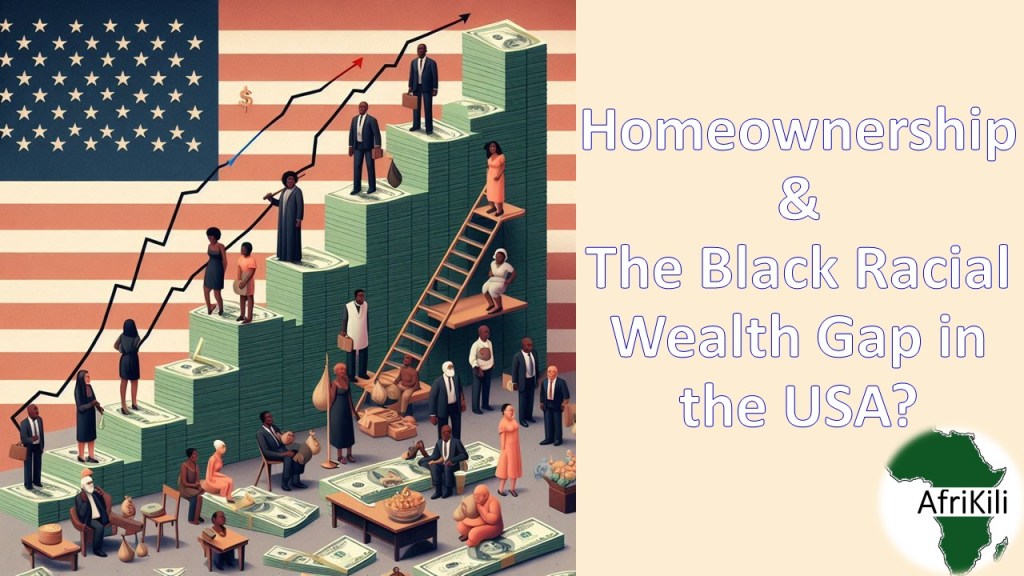
In the United States of America, the racial wealth gap represents one of the most persistent and significant disparities in the country’s socio-economic landscape, with Black Americans disproportionately affected. There are several factors deeply rooted in historical injustices and structural inequities, that have caused and sustained this enduring gap. This is evident when it comes to homeownership—a critical component of wealth accumulation. In this blog post, we’ll specifically delve into the inseparable connection between home ownership and the racial wealth gap in the United States by exploring the historical context, systemic barriers, and potential solutions.
“on average, White households possess almost ten times more wealth than their Black households.”
Over the last four decades, the racial wealth inequality gap has grown and continues to grow. According to a 2019 Federal Reserve report, the median wealth of White families was approximately $188,200, compared to just $24,100 for Black families. This means that, on average, White households possess almost ten times more wealth than their Black households.
It is worth noting that the lack of homeownership also limits opportunities for business development, as entrepreneurs often use home equity to start businesses.
The Black racial wealth gap is deeply rooted in systemic racism in the United States of America. Its origins can be traced back to the era of slavery, which was followed by a long period of systemic discrimination through Jim Crow laws, segregation, and discriminatory policies. One of the most impactful periods was the mid-20th century, when policies like the New Deal and the GI Bill provided unprecedented opportunities for homeownership and wealth-building—primarily for White Americans. These policies largely excluded Black Americans, who were systematically denied access to mortgages and affordable housing through practices like redlining.
“The Black racial wealth gap is deeply rooted in systemic racism in the United States of America.”
Redlining was a discriminatory practice that emerged in the 20th century and systematically denied loans and services to residents of certain neighborhoods based on race or ethnicity. This practice effectively denied wealth accumulation opportunities to Black families by restricting their access to credit, mortgages, and insurance. Black families were denied many opportunities to build wealth through home equity.
Several current factors such as income disparities and home appraisal bias continue to worsen the homeownership disparity and, by extension, the racial wealth gap.
Black households typically have lower average incomes than White households, limiting their ability to save for down payments and afford mortgages. Additionally, Black families often face more stringent credit criteria and higher interest rates, making homeownership more expensive and less accessible.
Appraisal bias also hinders wealth accumulation through homeownership because homes in predominantly Black neighborhoods are frequently appraised at lower values than similar homes in White neighborhoods. This devaluation reduces the potential for building significant home equity, further limiting wealth accumulation for Black homeowners.
“Ultimately, the racial wealth gap and homeownership disparity will not be adequately addressed without a multifaceted approach.”
More recently, the COVID-19 pandemic exacerbated existing disparities, with Black families experiencing higher rates of job loss and economic instability, further hindering their ability to buy and maintain homes. Additionally, gentrification in urban areas has displaced long-term Black residents, reducing their ability to benefit from rising property values.
Ultimately, the racial wealth gap and homeownership disparity will not be adequately addressed without a multifaceted approach. Here are a few possible solutions:
Policy reforms: strengthen fair housing laws, increase funding for affordable housing, implement policies to prevent displacement due to gentrification, and address discriminatory lending practices.
Economic development: Supporting economic development in predominantly Black neighborhoods can increase property values and create more homeownership opportunities.
Education and Counseling: Empower potential buyers with knowledge about the homebuying process by providing financial literacy education and homeownership counseling.
Affordable Housing Initiatives: encourage public-private partnerships to develop affordable housing units and increase funding for affordable housing programs, including down payment assistance and rental subsidies.
Reform Credit Scoring Systems: reduce reliance on credit scores for mortgage approvals and explore alternative credit scoring models that consider factors beyond traditional credit history.
Conclusion
In the United States, the Black racial wealth gap and homeownership disparity are deeply intertwined and rooted in both historical and systemic inequities. Bridging this gap requires concerted efforts across policy, community development, and individual support, to create equitable opportunities for wealth building through homeownership. By dismantling systemic barriers and promoting equitable homeownership, we can work toward a more just and equitable society where all families have a fair shot at building wealth through homeownership and securing their financial futures.
Let’s get inspired!
I will close with a quote from Booker T. Washington (1856-1915), one of the leading African American intellectuals of the 19 century and founder of both the Tuskegee Normal and Industrial Institute (Now Tuskegee University) in 1881 and the National Negro Business League: “Associate yourself with people of good quality, for it is better to be alone than to be in bad company.”
“Associate yourself with people of good quality, for it is better to be alone than to be in bad company.” ― Booker T. Washington
#AfriKili nation, there are people of good quality across the global pan-African diaspora. Let us associate and build bridges in order to create powerful coalitions that will span continents and generations.
Until next time, peace be with you. Asante Sana!
Let’s get to work!
AfriKili
African Intelligence to Build Bridges in Africa and The Global Pan-African Diaspora! *** Intelligence Africaine pour Construire des Ponts en Afrique et la Diaspora Pan-Africaine Mondiale ! *** Akili ya Kiafrika wa Kujenga Madaraja barani Afrika na Diaspora ya Kimataifa ya Pan-Afrika!



 AfriKili
Leave a comment